cell body reorganization in the spinal cord after sympathectomy

The amount of compensatory sweating depends on the patient, the damage that the white rami communicans incurs, and the amount of cell body reorganization in the spinal cord after surgery.
Other potential complications include inadequate resection of the ganglia, gustatory sweating, pneumothorax, cardiac dysfunction, post-operative pain, and finally Horner’s syndrome secondary to resection of the stellate ganglion.
www.ubcmj.com/pdf/ubcmj_2_1_2010_24-29.pdf

After severing the cervical sympathetic trunk, the cells of the cervical sympathetic ganglion undergo transneuronic degeneration
After severing the sympathetic trunk, the cells of its origin undergo complete disintegration within a year.

http://onlinelibrary.wiley.com/doi/10.1111/j.1439-0442.1967.tb00255.x/abstract

Sunday, November 24, 2013

sympathectomized arteries become more susceptible to lipid accumulation

Combined effect of cholesterol feeding and sympathectomy on the lipid content in rabbit aortas
Volume 37, Issue 4, December 1980, Pages 521–528

Saturday, November 23, 2013

Decreased HRV is predictive of adverse cardiovascular outcomes in a variety of disease states

Water immersion-induced skin wrinkling (WISW) is dependent on intact peripheral sympathetic function. WISW was hypothesized to reflect autonomic function in subjects with- out peripheral neuropathy. We prospectively studied 70 healthy subjects (aged 31 88 years, 63% females) without cardiovascular risk factors or neurological disease. All sub- jects underwent short-term heart rate variability (HRV) stud- ies. Time and frequency domain variables were derived in- cluding the HRV index. WISW was graded using a previously validated scale of 1–4 of which 18.6% of subjects exhibited grade 1 (minimal) WISW and 35.7% had grade 2 WISW. On multivariate analysis using the HRV index, WISW was inde- pendently related to height and the HRV index. We conclude that WISW is related to central autonomic function.


Although the mechanism is not fully understood, WISW is felt to be caused by passive diffusion of water across the stratum corneum into the sweat ducts, which in turn alters electrolyte balance, decreases membrane stabilization, increases sympathetic neural firing and stimulates vasoconstriction [1–3, 8].WISW is decreased in diabetic patients and in patients after cervical sympathectomy [4, 9].
Heart rate variability (HRV) is the beat-to-beat variation in cardiac cycle length due to autonomic influence on the sinus node. Decreased HRV is predictive of adverse cardiovascular outcomes in a variety of disease states[5]. The influence of the central nervous system activity on autonomic function suggests that HRV may be a useful prognostic indicator in patients with cerebrovascular events [6].


Cardiology 2010;116:247–250 DOI: 10.1159/000316043
Received: May 10, 2010
Accepted after revision: May 28, 2010 Published online: August 18, 2010

Thursday, October 31, 2013

electric stimulation of the sympathetic cord in the upper thoracic level on the middle cerebral artery blood flow velocity


The effect of electric stimulation of the sympathetic cord in the upper thoracic level on the middle cerebral artery blood flow velocity (V(MCA)) in humans was examined using transcranial Doppler sonography monitoring during surgery for palmar hyperhidrosis. Sympathetic stimulation resulted in marked and rapid increases Of V(MCA). The responses were preceded by prompt increases of mean arterial blood pressure (MABP) and heart rate (HR). Division of the sympathetic cord cranially or caudally to the stimulation site partially reduced the V(MCA), MABP and HR responses. Both these operations reduced sympathetic pathways to the heart as reflected by a decrease in HR and MABP. The integrity of the sympathetic pathway from the stimulation site through the superior cervical ganglion and the carotid plexus was not a prerequisite for a V(MCA) response. Our data suggest that the V(MCA) increase mainly results from stimulation of the heart and the cardiovascular system, resulting in marked increases of blood pressure and heart rate.

CEREBROVASCULAR DISEASES Volume: 2 Issue: 6 Pages: 359-364 Published: NOV-DEC 1992

Sunday, September 15, 2013

Cerebral sympathetic nerve activity has a major regulatory role in the cerebral circulation in REM sleep


Source

Ritchie Centre for Baby Health Research, Monash Institute of Medical Research, Monash University, Melbourne, Australia.

Abstract

Sympathetic nerve activity (SNA) in neurons projecting to skeletal muscle blood vessels increases during rapid-eye-movement (REM) sleep, substantially exceeding SNA of non-REM (NREM) sleep and quiet wakefulness (QW). Similar SNA increases to cerebral blood vessels may regulate the cerebral circulation in REM sleep, but this is unknown. We hypothesized that cerebral SNA increases during phasic REM sleep, constricting cerebral vessels as a protective mechanism against cerebral hyperperfusion during the large arterial pressure surges that characterize this sleep state. We tested this hypothesis using a newly developed model to continuously record SNA in the superior cervical ganglion (SCG) before, during, and after arterial pressure surges occurring during REM in spontaneously sleeping lambs. Arterial pressure (AP), intracranial pressure (ICP), cerebral blood flow (CBF), cerebral vascular resistance [CVR = (AP - ICP)/CBF], and SNA from the SCG were recorded in lambs (n = 5) undergoing spontaneous sleep-wake cycles. In REM sleep, CBF was greatest (REM > QW = NREM, P < 0.05) and CVR was least (REM < QW = NREM, P < 0.05). SNA in the SCG did not change from QW to NREM sleep but increased during tonic REM sleep, with a further increase during phasic REM sleep (phasic REM > tonic REM > QW = NREM, P < 0.05). Coherent averaging revealed that SNA increases preceded AP surges in phasic REM sleep by 12 s (P < 0.05). We report the first recordings of cerebral SNA during natural sleep-wake cycles. SNA increases markedly during tonic REM sleep, and further in phasic REM sleep. As SNA increases precede AP surges, they may serve to protect the brain against potentially damaging intravascular pressure changes or hyperperfusion in REM sleep.
PMID:
 
19150858
 
[PubMed - indexed for MEDLINE] 
Free full text

Wednesday, August 14, 2013

cilio-spinal center can extend to T5


The ciliospinal reflex (pupillary-skin reflex) consists of dilation of the ipsilateral pupil in response to pain applied to the neck, face, and upper trunk. If the right side of the neck is subjected to a painful stimulus, the right pupil dilates (increases in size 1-2mm from baseline). This reflex is absent in Horner's syndrome and lesions involving the cervical sympathetic fibers. The enhanced ciliospinal reflex in asymptomatic patients with cluster headache is due to preganglionic sympathetic mechanisms.
http://en.wikipedia.org/wiki/Ciliospinal_reflex


The cilio-spinal center is not sharply confined to TI spinal level, but may extend downwards as low as T5

Tuesday, August 6, 2013

High plasma norepinephrine and depression

Copyright © 1999 Society of Biological Psychiatry. Published by Elsevier Science Inc.

Plasma norepinephrine and prediction of outcome in major depressive disorder
Timothy G. Johnstona, Christopher B. Kellya, Michael R. Stevensonb and Stephen J. Coopera 
a Department of Mental Health, Whitla Medical Building, The Queen’s University of Belfast, Belfast, UK (TGJ, CBK, SJC)
b Department of Medical Statistics, Mulhouse Building, The Queen’s Unversity of Belfast, Belfast, UK (MRS)
Received 1 February 1999; revised 17 May 1999; accepted 21 May 1999. Available online 30November 1999.
Background: Several epidemiologic and clinical factors have been shown to predict long term outcome in major depressive disorder (MDD). The value of biological predictors has not been extensively studied. This study examined whether plasma norepinephrine may be useful in predicting outcome in MDD.
Methods: Forty patients were followed up 8 years after an index major depressive episode. Three outcome variables were assessed: time to first recurrence (the primary outcome measure), the Lee and Murray criteria and the Depression Outcome Scale (DOS). The results were examined against plasma norepinephrine value, at the index episode, using survival analysis and linear regression.

Results: High plasma norepinephrine at the index episode was positively and significantly associated with time to first recurrence for patients with nonpsychotic MDD (n = 31, χ2 = 8.38, on 1 df, p < .01). Similarly, plasma norepinephrine was significantly associated with good global outcome, both using Lee and Murray criteria (n = 34, adjusted R2 = .24, p < .01) and DOS criteria (n = 31, adjusted R2 = .17, p < .01) for this group of patients. In contrast, plasma norepinephrine was not significantly related to outcome for MDD with psychotic features.
Conclusions: Plasma norepinephrine at index episode seems to be a predictor of outcome in MDD.

A neurotransmitter involved in emotional arousal enhances learning

A neurotransmitter involved in emotional arousal enhances learning by phosphorylating glutamate receptors.

Do you remember the song that was playing during your first kiss? Both positive and negative emotions influence learning and memory but researchers have not determined the mechanism. Now Hu et al. report that the neurotransmitter norepinephrine regulates glutamate receptor trafficking in a recent article in Cell.
Axon terminals containing norepinephrine synapse in the hippocampus and amygdala, which are important in emotional memory. In the hippocampus, norepinephrine reduces the threshold for long-term potentiation (LTP), which is thought to be a substrate of memory. Norepinephrine acts at pastedGraphic.pdf-adrenergic receptors, where it activates cAMP-dependent protein kinase (PKA) and calcium/calmodulin-dependent protein kinase II (CaMKII). These kinases phosphorylate serines 845 and 831, respectively, in the AMPA glutamate receptor type 1 (GluR1). The authors proposed that norepinephrine regulates learning by phosphorylating AMPA receptors.
Hu, H. et al. Emotion enhances learning via norepinephrine regulation of AMPA-receptor trafficking. Cell 131, 160–173 (2007). | Article | PubMed |


Emotional intelligence
Neuroscience Gateway (October 2007) | doi:10.1038/aba1787

Thursday, August 1, 2013

RSD due to nerve injury


According to the National Institute of Neurological Disorders and Stroke (NINDS), RSD is "a chronic pain condition that is believed to be the result of dysfunction in the central or peripheral nervous systems." According to MedicineNet, RSD involves "irritation and abnormal excitation of nervous tissue, leading to abnormal impulses along nerves that affect blood vessels and skin."
Animal studies indicate that norepinephrine, a catecholamine released from sympathetic nerves, acquires the capacity to activate pain pathways after tissue or nerve injury, resulting in RSD. Another theory suggests that RSD, which follows an injury, is caused by triggering an immune response and symptoms associated with inflammation (redness, warmth, swelling). RSD is not thought to have a single cause, but rather multiple causes producing similar symptoms.
http://arthritis.about.com/od/rsd/a/rsd.htm

Saturday, July 20, 2013

sympathectomy led to significant decrements in escape and avoidance responding

PsycNET - Option to Buy: "Chemical sympathectomy and avoidance learning in the rat.
By Di Giusto, E. L.; King, M. G.
Journal of Comparative and Physiological Psychology, Vol 81(3), Dec 1972, 491-500.
Abstract
Reports results of 5 experiments with male Wistar rats (N = 108). Depletion of peripheral sympathetic noradrenaline induced by administration of 6-hydroxydopamine, ip, led to significant decrements in escape and avoidance responding when the required response was difficult, but not when it was relatively easy to acquire. Results are similar to previous findings obtained with adrenal-demedullated Ss. Findings clarify the role of the sympathetic nervous system in the motivation of behavior elicited by aversive stimulation. Implications for 2-process theory and the "Kamin effect," or "learned helplessness," are discussed. (40 ref.) (PsycINFO Database Record (c) 2012 APA, all rights reserved)"

Sunday, July 7, 2013

Patients report that they feel less anxious in stressful situations. Stage fright is reduced. The results are usually permanent.

http://neuro.templehealth.org/content/ETShyperhidrosis.htm

peripheral autonomic denervation affects fear and arousal

States of peripheral autonomic arousal are represented within brain regions that overlap those implicated in emotion Critchley et al. 2000aCritchley et al. 2000bCritchley et al. 2001aCritchley et al. 2001b and Critchley et al. 2001c. Moreover, activity within areas involved in central autonomic control is modulated by feedback of peripheral autonomic responses (Critchley et al., 2001a). These autonomic arousal states bias emotional behavior and influence processes such as memory (e.g., Damasio et al. 1990,Cahill et al. 1994 and Cahill and McGaugh 1998). For example, amygdala is associated with memory enhancement for emotional material, a process thought to be mediated through the influence of states of arousal on amygdalo-hippocampal functional connectivity Cahill et al. 1994Cahill and McGaugh 1998 and Cahill et al. 1999. Peripheral autonomic arousal may also influence conditioning, as suggested by pharmacological and motivational manipulations in animals Young et al. 1995 and Maren et al. 1994.
http://www.sciencedirect.com/science/article/pii/S0896627302005883

Thursday, June 27, 2013

Sympathectomy (ETS or ESB) can alleviate socia phobia and common fears such as fear of flying, heights, open spaces, or the darkness

Is sympathectomy the new lobotomy?

"ESB may also alleviate social phobia and common fears such as fear of flying, heights, open spaces, or the darkness. In addition, it can be used to decrease trembling of the body, hands, and voice, even stuttering. It may help in alcoholism or drug withdrawal, because these are often linked with social anxiety. 
Sympathetic block is a gentle and exact endoscopic procedure. It is performed as day surgery under light anesthesia."
http://www.sympatix.fi/?lang=en

Friday, January 11, 2013

Patients complain of emotional blunting following endoscopic thoracic sympathectomy for hyperhidrosis and blushing


Hohmann, G.W. : The effect of dysfunction of the autonomic nervous system on experienced feelings and emotions
Paper read at Conference on Emotions and Feelings at New School for Social Research, New York, Oct 1962.
Sherrington, C.S.: Experiments on the value of vascular and visceral factors for the genesis of emotion 
Proc. Roy.Soc., 1900, 66, 390-403
Wenger, M.A.: Emotion as visceral action: an extension of Lange's theory. In Reymert, M.L., Feelings and emotions: the Moosehart ymposium, New York: McGraw-Hill, 1950. Pp.3-10.
Wynne, L.C., and Solomon, R.L.: Traumatic avoidance learning: acquisition and extinction in dogs deprived of normal peripheral autonomic function. 
Genet. psychol. Monogr., 1955, 52, 241-84
Landis, C., and Hunt, W. A. Adrenalin and emotion. 
Psychol. Rev., 1932, 39, 467-85.
Schachter, S., and Wheeler, L.: Epinephrine, chlorpromazine, and amusement. 
J. of abnorm. soc. Psychol., 1962, 65, 121-28.

Wednesday, January 2, 2013

in the absence of autonomic arousal, behavior that appears emotional will not be experienced as emotional


"In the presence of a barking dog, for example, the sympathectomized cats manifested almost all of the signs of feline rage. Finally, Cannon notes the report of Dana (1921) that a patient with a spinal-cord lesion and almost totally without visceral sensation still manifested emotionality.
For either the Jamesian or the present formulation such data are crucial, since both views demand visceral arousal as a necessary condition for emotional arousal. When faced with this evidence, James's defenders (e.g., Wenger, 1950; Mandler, 1962) have consistently made the point that the apparently emotional behavior manifested by sympathectomizied animals and men is well-learned behavior, acquired long before sympathectomy. There is a dual implication in this position: first, that sympathetic arousal facilitates the acquisition of emotional behavior, and second, that sympathectomized subjects act but do not feel emotional. There is a small but growing evidence supporting these contentions. Wynne and Solomon (1955) have demonstrated that sympathectomized dogs acquire an avoidance response considerably more slowly than control dogs. Further, on extinction trials most of their 13 sympathectomized animals extinguished quickly, whereas not a single one of the 30 control dogs gave any indication of extinction over 200 trials. Of particular interest are two dogs who were sympathectomized after they had acquired the avoidance response. On extinction trials these two animals behaved precisely like the control dogs - giving no indication of extinction. Thus, when deprived of visceral innervation, animals are quite slow in acquiring emotionally-linked avoidance responses and in general, quick to extinguish such responses." (p. 163)

"A line of thought stimulated by the Wynne and Solomon (1955) and the Hohmann (1962) studies may indeed be the answer to Cannon's observations that there can be emotional behavior without visceral activity. From the evidence of these studies, it would appear, first, that autonomic arousal greatly facilitates the acquisition of emotional behavior but it is not necessary for its maintenance if the behavior is acquired prior to sympathectomy; and second, that in the absence of autonomic arousal, behavior that appears emotional will not be experienced as emotional." (p. 167)

Psychobiological Approaches to Social Behavior

P. Herbert LeidermanDavid ShapiroHarvard Medical School. Dept. of PsychiatryUnited States. Office of Naval Research - 1964 - 203 pages

Monday, December 10, 2012

The vasodilating effect of spinal dorsal column stimulation is mediated by sympathetic nerves - Springer

The vasodilating effect of spinal dorsal column stimulation is mediated by sympathetic nerves - Springer: "Immediately after sympathectomy, the contralateral right arm became increasingly cold and cyanotic and the patient complained of chronic painful coldness and severe cold-intolerance in the right arm. Attempts to pharmacologically vasodilate the arm with felodipine did not affect the local vasoconstriction and pain. Dorsal column stimulation (associated with symmetrical paraesthesia in both arms) induced an immediate and marked (ten-fold) increase in skin blood flow in the right arm (and in the leg), whereas skin blood flow in the left arm remained unaffected. The lack of vasomotor response in the left arm was not due to maximal vasodilatation at rest, since skin blood flow in the left arm showed a normal capacity for axon reflex vasodilatation following antidromic activation of sensory afferents. The results suggest that the marked vasodilatation induced by dorsal column stimulation is mediated by sympathetic vasomotor fibres, via modulation of central neuronal circuits involved in the regulation of skin sympathetic discharge."

'via Blog this'

Saturday, December 1, 2012

Transection below T8-T10 is not accompanied by reflex sweating

Reflex sweating in patients with spina... [Arch Phys Med Rehabil. 1977] - PubMed - NCBI: "Sweat glands derive their innervation from the sympathetic nervous system. The spinal sympathetic structures that are located in the intermediolateral areas extend from T1-L2 segments and are under the control of hypothalamic centers. Cord transection abolishes the supraspinal control of sudorimotor function. Since sympathetic innervation does not follow a clear segmental distribution, normal sweating may be preserved at a higher or lower level than skin sensation. Nonthermoregulatory reflex sweating is an indication of unchecked spinal cord facilitation and is precipitated by afferent stimuli from bladder, rectum, and various other sources. It is usually a manifestation of mass reflex or autonomic crisis and occurs particularly in cervical or high thoracic lesions. Transection below T8-T10 is not accompanied by reflex sweating. The phenomenon of thermal relfex sweating is controversial. Although some aspects of nonthermoregulatory reflex sweating are still unclear, proper immediate and continuing preventive management will reduce the incidence of this and other autonomic manifestations. "

'via Blog this'

Monday, November 26, 2012

Hemodynamic changes in vertebral and carotid arteries were observed after sympathicotomy for hyperhidrosis


T3 sympathicotomy segment was the most frequent transection done (95.83%), as only ablation (25%) or in association with T4 (62.50%) or with T2 (8.33%). It was observed increase in RI and PI of the common carotid artery (p &lt; 0.05). The DPV of internal carotid artery decreased in both sides (p &lt; 0.05). The SPV and the DPV of the right and left vertebral arteries also increased (p &lt; 0.05). Asymmetric findings were observed so that, arteries of the right side were the most frequently affected.

CONCLUSIONS: Hemodynamic changes in vertebral and carotid arteries were observed after sympathicotomy for PH. SPV was the most often altered parameter, mostly in the right side arteries, meaning significant asymmetric changes in carotid and vertebral vessels. Therefore, the research findings deserve further investigations to observe if they have clinical inferences.
http://www.ncbi.nlm.nih.gov/pubmed/16186983 

Thursday, October 25, 2012

Research indicates that a highly variable heart rate increases your capacity to respond and adapt to life’s challenges.

Research has shown that reductions in heart rate variability are a predictor of sudden cardiac death, even in individuals without a prior history of cardiovascular disease.

http://theconversation.edu.au/depression-can-break-your-heart-literally-1102

Monday, October 22, 2012

Unexpected beneficial effect of stellate ganglion block in a schizophrenic patient

Unexpected beneficial effect of stella... [Can J Anaesth. 2002 Aug-Sep] - PubMed - NCBI: "Unexpected beneficial effect of stellate ganglion block in a schizophrenic patient"

Stellate ganglion block may relieve hot flashes by interrupting the sympathetic nervous system

Stellate ganglion block may relieve hot flash... [Med Hypotheses. 2007] - PubMed - NCBI: "the wide range of conditions that have been reported to respond favorably to stellate ganglion block suggest that its effectiveness may not be solely the result of increased blood flow nor restricted just to its sphere of innervation. We have found that stellate ganglion block is effective in the treatment of hot flashes in postmenopausal women, as well as those with estrogen depletion resulting from breast cancer treatment. Based on evidence that hot flashes may be centrally mediated and that the stellate ganglion has links with the central nervous system nuclei that modulate body temperature, we hypothesize that the stellate ganglion block provides relief of hot flashes by interrupting the central nervous system connections with the sympathetic nervous system, allowing the body's temperature-regulating mechanisms to reset. If this mechanism can be confirmed, this would provide women with intractable hot flashes with an effective, potentially long-lasting means of relieving their symptoms, and potentially widen the range of indications for stellate ganglion block to include other centrally mediated syndromes."

'via Blog this'

Thursday, October 18, 2012

These observations further emphasize our ignorance of the mechanisms responsible for primary hyperhidrosis and of the effect of sympathetic ablation


"These observations further emphasize our ignorance of the mechanisms responsible for primary hyperhidrosis and of the effect of sympathetic ablation on the function of the remaining sympathetic system."  

"Only investigators who deviate from accepted standards innovate and thus advance science. Obviously, such deviations may also result in disasters;"  

Statement made by the former President of the International Society of Sympathetic Surgery,  and ETS surgeon, Moshe Hashmonai (Invited Commentary)   Endoscopic Lumbar Sympathectomy Following Thoracic Sympathectomy in Patients with Palmoplantar Hyperhidrosis    

World J Surg (2011) 35:54–55 DOI 10.1007/s00268-010-0809-5

Monday, September 24, 2012

Post-sympathectomy pain

Postsympathectomy limb pain, postsympathectomy parotid pain, and Raeder's paratrigeminal syndrome are pain states associated with the loss of sympathetic fibres and in particular with postganglionic sympathetic lesions. There is a characteristic interval of about 10 days between surgical sympathectomy and onset of pain. It is proposed that this pain in man is correlated with the delayed rise in sensory neuropeptides seen in rodents after sympathectomy. These chemical changes probably reflect the sprouting of sensory fibres and may result from the greater availability of nerve growth factor after sympathectomy. The balance between the sensory and sympathetic innervations of a peripheral organ may be determined by competition for a limited supply of nerve growth factor.
Lancet. 1985 Nov 23;2(8465):1158-60
http://www.ncbi.nlm.nih.gov/pubmed/2414615?dopt=Abstract

A significant admission from an ETS surgeon, President of the ISSS:

"General represents the ESB (whether as ETS as ETSC or ELS) a substantial interference in regulatory processes of the body represent the decision for this operation requires that previously conservative treatments were made. An ESB is therefore at the end of a treatment history, and never at the beginning."
http://www.dhhz.de/index....;subPage=&section=32

it is an automatic translation (google) from german, so you have to look at what the 'gist' of what he is saying: ETS, ESB = "a substantial interference in regulatory processes of the body"

Friday, August 31, 2012

Wednesday, August 15, 2012

"sympathectomy highlighted the disparity between what is known in practice and what appears in the literature"


The March 2004 edition was quite outstanding, with an excellent editorial reminding the reader that only good results are published. The review on thoracoscopic sympathectomy highlighted the disparity between what is known in practice and what appears in the literature. 
‘Know Your Results’, the topic of the ASGBI Annual Scientific Meeting, is of outstanding importance; what is more, the surgeon has to go on knowing his/her results to ensure standards of practice do not slip.
The Journal appreciates comments and criticism and the correspondence column remains a crucial part of the BJS in its interaction between editors and reader. It is also part of the scientific process.
A more robust and incisive criticism of articles known to be flawed would prevent the retractions that have recently been published in the Lancet.
Christopher Russell, Chairman, BJS Society
Association of Surgeons of Great Britain and Ireland, ANNUAL REPORT 2004

Monday, August 13, 2012

sympathectomy induced morphological alterations in the masseter muscles


Sympathectomized animals showed varying degrees of metabolic and morphological alterations, especially 18 months after sympathectomy. The first five groups showed a higher frequency of type I fibres, whilst the oldest group showed a higher frequency of type IIb fibres. In the oldest group, a significant variation in fibre diameter was observed. Many fibres showed small diameter, atrophy, hypertrophy, splitting, and necrosis. Areas with fibrosis were observed. Thus cervical sympathectomy induced morphological alterations in the masseter muscles. These alterations were, in part, similar to both denervation and myopathy. These findings indicate that sympathetic innervation contributes to the maintenance of the morphological and metabolic features of masseter muscle fibres.

Sunday, August 12, 2012

Bilateral cervical sympathectomies should be avoided because of the destruction of cardioaccelerator tone

http://www.hiesiger.com/physicians/physicianrfl.html

SURGICAL SYMPATHECTOMY ON THE SENSITIVITY TO EPINEPHRINE OF THE BLOOD VESSELS OF MUSCULAR SEGMENTS OF THE LIMBS

Pursuing this study of the effect of epinephrine on muscle blood flow, Duff and Swan (10) reported that during intravenous epinephrine infusions the initial marked dilatation was succeeded by a second phase of moderate dilatation in normal but not in sympathectomized limbs. Because of its absence in chronically sympathectomized limbs this secondary vasodilatation was at that time thought to be an indirect vasomotor effect mediated by the sympathetic nerves. Re-examination of their data in the light of some subsequent critical experiments now reveals that the difference which they found between normal and sympathectomized limbs may be ascribed largely to vascular hypersensitivity in the later.
In the present paper these additional data are reported, and are incorporated with those of Duff and Swan(10); the whole material being interpreted to provide evidence that hypersensitivity of the vessels of skeletal muscle in the upper and lower limbs may result from pre- and postganglionic sympathectomy in man.
EFFECT OF SURGICAL SYMPATHECTOMY ON THE SENSITIVITY TO EPINEPHRINE OF THE BLOOD VESSELS OF MUSCULAR SEGMENTS OF THE LIMBS, ROBERT S. DUFF
J Clin Invest. 1953 September; 32(9): 851–857.
http://www.ncbi.nlm.nih.gov/pmc/articles/PMC438413/

Tuesday, June 12, 2012

Effects of lumbar sympathectomy: abolition of ejaculation, causalgia in 41, general morbidity of 0.6% and mortality rate of 0.6 %, arrhythmias, cardiac decompensation

Goldstein, reviewing the complications of 791 patients undergoing open lumbar sympathectomy reports 10% of specific complications, such as abolition of ejaculation in 22 patients and causalgia in 41, general morbidity of 0.6% (TEP and bleeding) and mortality rate of 0.6 % (arrhythmias, cardiac decompensation or bleeding) 15.

SIMPACTECTOMIA RETROPERITONEOSCÓPICA FOR TREATMENT OF LUMBAR plantar hyperhidrosis RETROPERITONEOSCOPIC lumbar sympathectomy FOR THE TREATMENT OF PLANT HYPERIDROSIS
Marcelo de Paula Loureiro, TCBC-PR ¹, ² Neomar Roman, Sheila Cristina Weigmann ³;
Aline ³ Fontana, Paulo Cesar Bufara Boscardim4
(Rev Bras ECR. Cir. 2007, 34 (4): 222-224).
(translated by google)

dynamic cerebral autoregulation is altered by ganglion blockade

We measured arterial pressure and cerebral blood flow (CBF) velocity in 12 healthy subjects (aged 29+/-6 years) before and after ganglion blockade with trimethaphan. CBF velocity was measured in the middle cerebral artery using transcranial Doppler. The magnitude of spontaneous changes in mean blood pressure and CBF velocity were quantified by spectral analysis. The transfer function gain, phase, and coherence between these variables were estimated to quantify dynamic cerebral autoregulation. After ganglion blockade, systolic and pulse pressure decreased significantly by 13% and 26%, respectively. CBF velocity decreased by 6% (P <0.05). In the very low frequency range (0.02 to 0.07 Hz), mean blood pressure variability decreased significantly (by 82%), while CBF velocity variability persisted. Thus, transfer function gain increased by 81%. In addition, the phase lead of CBF velocity to arterial pressure diminished. These changes in transfer function gain and phase persisted despite restoration of arterial pressure by infusion of phenylephrine and normalization of mean blood pressure variability by oscillatory lower body negative pressure.
Conclusions-: These data suggest that dynamic cerebral autoregulation is altered by ganglion blockade. We speculate that autonomic neural control of the cerebral circulation is tonically active and likely plays a significant role in the regulation of beat-to-beat CBF in humans.
Circulation. 106(14):1814-1820, October 1, 2002.
http://www.problemsinanes.com/pt/re/dyslipidaemia/abstract.00003017-200210010-00017.htm;jsessionid=PX6phQHYFG5PD1p2DMS1cJLvG1TbtLLLH0bfJT6vKJgLLx1zn0Xf!1816077220!181195629!8091!-1?nav=reference

Tuesday, June 5, 2012

effect of bilateral cervical sympathetic ganglionectomy on the architecture of pial arteries

The influence of the cranial sympathetic nerves on the architecture of pial arteries in normo- and hypertension was examined. For this purpose the effect of bilateral superior cervical ganglionectomy was evaluated in normotensive rats (WKY) and stroke-prone spontaneously hypertensive rats (SHRSP). The operations were performed at the age of 1 wk, which is just prior to the onset of ganglionic transmission. The length of the inner media contour was measured and the media cross-sectional area was determined planimetrically, with computerized digitalization of projected photographic images of transversely sectioned pial arteries. Four wk after sympathectomy there was a 20% reduction in media cross-sectional area and a consequent reduction in the ratio between media area and calculated luminal radius in the major pial arteries at the base of the brain in WKY but not in SHRSP. Conversely, in small pial arteries linear regression analysis showed that in WKY subjected to ganglionectomy the relationship between media cross-sectional area and luminal radius was significantly larger in arteries with a radius less than 21 microns compared to untreated WKY. No such effect was seen in the corresponding SHRSP vessels. In addition, the cross-sectional area of the internal elastic membrane (IEM) in the basilar arteries of WKY was measured by means of a computerized image-analysing system. Mean cross-sectional area of the IEM was approximately 45% larger following SE than in control animals. The present findings propose a 'trophic' role for the sympathetic perivascular nerves in large pial arteries of the rat. The increased media-radius ratio in the small pial arteries of the WKY following sympathectomy might reflect a compensatory hypertrophy due to reduced protection from the larger arteries against the pressure load. The inability to detect any morphometrically measurable effect of the sympathectomy in the cerebral arteries of SHRSP is probably explained by a marked growth-stimulating effect of the high pressure load in these animals.
http://www.ncbi.nlm.nih.gov/pubmed/7701941

Tuesday, May 29, 2012

significant fall in left circumflex coronary flow was proportional to the decline in external heart work due to sympathectomy

http://www.springerlink.com/content/k2n6j4555g16x773/

sympathectomy affects the heart, sweating, and circulation

heart rate was significantly reduced at rest (14%), at sub-maximal exercise (12.3%), and at peak exercise (5.7%), together with a significant increase in oxygen pulse (11.8, 12.7, and 7.8%, respectively). The rate pressure product (RPP) was also significantly reduced following the surgical procedure at all three study stages, while all other physiological variables measured remained unchanged. It is suggested that thoracic-sympathetic denervation affects the heart, sweating, and circulation of the respective denervated region

Eur J Appl Physiol. 2008 Sep;104(1):79-86. Epub 2008 Jun 10.

Sunday, May 20, 2012

Drug warning - Karvezide, AVAPRO HCT - 'you must tell your doctor if you have had sympathectomy'

Tell your doctor if:

* you have had a sympathectomy

* you have been taking diuretics

*you have a history of allergy or asthma


www.racgp.org.au/cmi/swckarvz.pdf


2. Before you start to take AVAPRO HCT

Tell your doctor if:
  • you suffer from any medical conditions especially-
    - kidney problems, or have had a kidney transplant or dialysis
    - heart problems
    - liver problems, or have had liver problems in the past
    - diabetes
    - gout or have had gout in the past
    - lupus erythematosus
    - high or low levels of potassium or sodium or other electrolytes in your blood
    - primary aldosteronism
  • you are strictly restricting your salt intake
  • you are lactose intolerant or have had any allergies to any other medicine or any other substances, such as foods, preservatives or dyes.
  • have had a sympathectomy
  • you have been taking diuretics
  • you have a history of allergy or asthma
http://www.mydr.com.au/medicines/cmis/avapro-hct-300-25-tablets

Published by MIMS/myDr March 2011
UBM Medica Australia uses its best endeavours to ensure that at the time of publishing, as indicated on the publishing date for each resource (e.g. Published by MIMS/myDr January 2007), the CMI provided was complete to the best of UBM Medica Australia's knowledge.  

Thursday, May 17, 2012

Use of stellate ganglion block for the treatment of psychiatric and behavioral disorders

The present invention is directed to a method for the treatment of a patient suffering from psychiatric and behavioral disorders, including post partum depression, post traumatic stress disorder, compulsive smoking, attention deficit hyperactivity disorder, gambling addiction, comprising the step of administering a stellate ganglion block to the patient to alleviate the symptoms. The stellate ganglion block may be followed by a sympathectomy to provide permanent relief.


Kind Code: A1
http://www.freepatentsonline.com/y2007/0135871.html

Saturday, May 5, 2012

nerves that sent blood-pressure-raising flight-or-fight signals to the brain were cut

page 187:
It was a grueling operation called sympathectomy, in which the nerves that sent blood-pressure-raising flight-or-fight signals to the brain were cut...The nerve cutting scrambled signals to her circulatory system. She was cold on one side of her body and warm on the other.

The Happy Bottom Riding Club: The Life and Times of Pancho Barnes (Paperback)

by Lauren Kessler (Author)

Wednesday, April 25, 2012

Sympathectomy increased the pain threshold and made the sympathectomized rats hypesthetic

Normal adult rats were sympathectomized at L2-L3. The threshold for thermal noxious pain by hot-plate analgesia test and changes in neuropeptides in the lumbar dura mater and dorsal root ganglia using light microscopic immunohistochemistry were assessed and compared with control rats.
Results: In the hot-plate analgesia test, sympathectomized rats increased their hot-plate latency time compared with that of sham-operated rats. Density of calcitonin gene-related peptide immunoreactive fibers in sympathectomy side of the lumbar dura mater decreased to 45.5% compared with the contralateral side. The number and size of calcitonin gene-related peptide immunoreactive cells in dorsal root ganglia showed no difference between sympathectomized and contralateral side.
Conclusion: Sympathectomy increased the pain threshold and made the sympathectomized rats hypesthetic. A large numbers of sensory fibers innervated the lumbar dura mater via L2-L3 sympathetic nerve in rats. Sympathectomy reduced the number of these nerve fibers in the lumbar dura mater. Sympathetic nerves may play an important role for low back pain involving the lumbar dura mater.
http://journals.lww.com/spinejournal/Abstract/1996/04150/An_Anatomic_Study_of_Neuropeptide.4.aspx

Long-term sympathectomy induces sensory and parasympathetic fibres sprouting, and mast cell activation in the rat dura mater

http://discovery.ucl.ac.uk/1330488/

There are similarities between the delayed onset of the human pain state and the delayed rise in sensory peptides after sympathectomy

The effect of sympathectomy on the calcitonin gene-related peptide (CGRP) level in the rat primary trigeminal sensory neurone was investigated. Six weeks after bilateral removal of the superior cervical ganglion there was a 70% rise in the CGRP content of the iris and the pial arteries, a 34% rise in the concentration in the trigeminal ganglion but no change in the brainstem. The CGRP rise in both end organs suggests that this phenomenon may be common to all peripheral organs receiving combined sensory and sympathetic innervations. The lack of any rise in the brainstem CGRP content raises the possibility that this process spares central terminations. In contrast, the level of neuropeptide Y, a peptide mainly contained in sympathetic terminals, fell to 35% of control values in the iris and pial arteries whilst the trigeminal ganglion and brainstem concentrations remained unchanged. The possible relevance of these observations to the clinical syndrome of postsympathectomy pain (sympathalgia) is discussed. There are similarities between the delayed onset of the human pain state and the delayed rise in sensory peptides after sympathectomy.
http://www.ncbi.nlm.nih.gov/pubmed/3877546

sympathectomy resulted in complete disappearance of histochemically detected adrenergic and a considerable decrease of cholinergic nerve fibers in the pial arterial walls

sympathectomy resulted in complete disappearance of histochemically detected adrenergic and a considerable decrease of cholinergic nerve fibers in the pial arterial walls. The vasodilatation was much less obvious in sympathectomized than in control animals. This was associated with (and probably caused by) a considerable rise in histochemically detected serotonin activity of the pial arteries walls. After recovery of blood supply to the brain the constriction of the pial arterial active segments restricting the excessive cerebral blood flow, was significantly reduced due, probably, to the sympathetic deprivation. Therefore, the sympathetic control plays an important part in pial arterial responses regulating the adequate blood supply of the cerebral cortex.
http://www.ncbi.nlm.nih.gov/pubmed/7173422

Monday, April 23, 2012

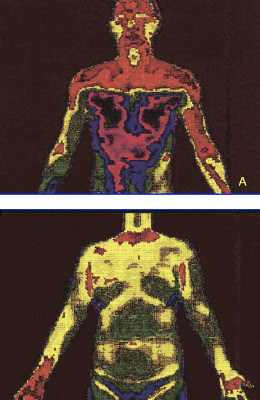
Digital infrared thermal image after T2 sympathicotomy or T3 ramicotomy.

(A) Clear cut change of skin temperature after a T2 sympathicotomy. (B) An even distribution of skin temperature after ramicotomy.
Gossot and colleagues [8] analyzed a group of T2, T3, T4 sympathectomy patients in comparison with a group of patients undergoing a T2, T3, T4 ramicotomy and they reported no statistical difference regarding the incidence of CS between the two groups studied (72.2% and 70.9%). However in terms of the severity of CS (embarrassing, disabling) causing inconveniences to daily life, they reported 27% and 13% incidences in these two groups, respectively. These findings suggest that by preserving the sympathetic trunk, it was possible to reduce the severity of CS.
The preganglionic fibers of the sympathetic nerve to the arm originate mostly from the spinal segments T3–T6 and the postganglionic fibers of the sympathetic nerve to the arm originate from T2 and, to a lesser extent, the T3 ganglia [9]. This implies that the division of preganglionic fibers (rami communicantes) reduces the extent of denervation of the sympathetic nerve as compared with the division of postganglionic fibers (sympathetic trunk) in the treatment of palmar hyperhidrosis.
Sympathectomy or sympathicotomy is one of the procedures used to divide the sympathetic trunk. Sympathicotomy distinctively changes sympathetic nerve distribution in comparison with a ramicotomy. Figure 4A illustrates the clear-cut changes of skin temperature after a T2 sympathicotomy. However the overall sympathetic nerve distribution to the body is not markedly changed after a T3 ramicotomy because a T3 ramicotomy is a procedure that is used to divide one of the preganglionic fibers and to preserve the sympathetic trunk. Figure 4B illustrates an even distribution of skin temperature after T3 ramicotomy.
 http://ats.ctsnetjournals.org/cgi/content/full/78/3/1052#FIG4

Tuesday, April 10, 2012

most surgeons do not have a clear understanding of their short-term outcomes for the majority of procedures they perform

The public would probably be surprised to know that most surgeons do not have a clear understanding of their short-term outcomes for the majority of procedures they perform.

Of even greater concern is the lack of data on long-term outcomes associated with surgical interventions.

Many surgeons argue that they are too busy and do not have the time and resources to conduct this sort of follow-up. This is not entirely without foundation, but it does seem difficult to defend a stance that says “I will continue to work feverishly at the operations I do but not assess how successful my results are”.

Guy Maddern (ASERNIP-s): No excuse for poor surgical outcomes

MJA INSIGHT, 8 August 2011

Monday, March 12, 2012

It’s not unusual to hear people who have undergone sympathectomies describe themselves as feeling emotionally “colder” than before

It’s not unusual to hear people who have undergone sympathectomies describe themselves as feeling emotionally “colder” than before. Among psychologists and neurologists alike there is concern, but no evidence, that the procedure limits alertness and arousal as well as fear, and might affect memory, empathy and mental performance. Professor Ronald Rapee, the director of the Centre of Emotional Health at Sydney’s Macquarie University, says he’s counselled several people who complain of feeling “robot-like” in the long-term wake of the operation. “They’re happy they no longer blush, but they miss the highs and lows they used to feel.”
(John van Tiggelen, Good Weekend Magazine, The Age and the Sydney Morning Herald, 10th March 2012)

Friday, February 24, 2012

impairment of the CBF autoregulation after unilateral cervical sympathectomy

Although these findings argued against a neurogenic mechanism, James at al. (1969) reported impairment of autoregulation after unilateral cervical sympathectomy in the babbon. Gotoh et al. (1971/1972) observed impairment of autoregulation in patients with the Shy-Drager syndrome.
It was concluded that the autonomic nervous system plays an important role in the mechanism of autoregulation of CBF and that his mechanism is independent of the chemical control of the cerebral vessels. This was confirmed by direct observation of the pial vessels in cats, where separate sites of action in the vascular tree for autoregulation and chemical control were demonstrated; the autoregulatory reaction was located in pial arteries with a diameter larger than 50 μ, and the reaction to carbon dioxide in pial arteries of smaller diameter (Gotoh et al. 1975).
They concluded that the arteries operating in autoregulation were the larger ones with the dense innervation, while the smaller arteries with sparse innervation were involved in chemical control.
Coronna and Plum (1973) demonstrated the absence of CBF autoregulation in a patient with a Shy-Drager syndrome who had a postganglionic denervation.

Gotoh et al (1979) subsequently showed that autoregulation in patients with this syndrome was impaired irrespective of the localization of the damage to the cervical sympathetic nervous system (preganglionic, central, postganglionic) as judged by the eye instillation test.
Handbook of Clinical Neurology,

Vascular Diseases, Part I by P. J. Vinken, G. W. Bruyn, H. L. Klawans, and J. F. Toole
, Volume 53, Part 1
Elsevier Health Sciences, 1988

Friday, February 17, 2012

reduced oxygen saturation and shallow respiration after a thoracoscopic sympathectomy

  1. D. J. Canty1,2,3,* and  C. F. Royse4,5
1Department of Anaesthesia, Royal Hobart Hospital, 48 Liverpool Street, Hobart, Tasmania 7000, Australia
  1. 2Medical School of The University of Tasmania, Tasmania, Australia
  2. 3Department of Pharmacology, The University of Melbourne, Melbourne, Australia
  3. 4Anaesthesia and Pain Management Unit, Department of Pharmacology, University of Melbourne, Melbourne, Australia
  4. 5Royal Melbourne Hospital, Victoria, Australia
  1. *Corresponding author. E-mail: david.canty@dhhs.tas.gov.au 
  2.     http://bja.oxfordjournals.org/content/103/3/352.full

CAUSES AND MANAGEMENT OF ORTHODEOXIA - The Australian Short Course on Intensive Care Medicine, 2005

DEFINE AND LIST THE CAUSES AND MANAGEMENT OF PLATYPNOEA AND
ORTHODEOXIA

p. 79:
Autonomic
o Parkinson disease (Hussain 2004)
o Bilateral thoracic sympathectomy (van Heerdon 2004)

Published in 2005 by
The Australasian Academy of Critical Care Medicine
“Ulimaroa”
630 St Kilda Rd, Melbourne,
Victoria 3004

ISSN 1327-4759

HAZARDS ASSOCIATED WITH CERVICO-THORACIC SYMPATHECTOMY

The following is a case report of a healthy 18-year-old woman who had bilateral Cervico- Thoracic sympathectomy done in two stages for severe hyperhidrosis in the palms of her hands.
Two episodes of asystolic arrest occurred during the 2nd stage left Cervico-Thoracic sympathec- tomy.

Thirty-five minutes after starting the operation, as the surgeon was retracting and dissecting the upper thoracic chain,
the cardiac monitor showed sudden onset of sinus bradycardia. The pulse rate was 50 beats per minute. Atropine 1·2 mg was given intravenously but cardiac asystole occurred.

External cardiac compression was started and another dose of atropine 1· 2 mg was given, followed by adrenaline 1·0 mg but there was no response. Following a second dose of adrenaline 1·0 mg and sodium bicarbonate 100 mEq, the
heart restarted with a marked sinus tachycardia.

The cause of hyperhidrosis apparently originates from some poorly understood stimulation of the sympathetic nervous system (Cloward 1969), and in sensitive patients this may possibly lead to excessive vagal stimulation to counteract it, as illustrated by the bradycardia and asystolic reaction to the sudden removal of the sympathetic control, and by the high doses of sympathomimetic drugs necessary to recommence cardiac activity. Anatomically the heart is innervated by the cardiac plexus which consists of the cardiac nerves derived from the cervical and upper thoracic ganglia of the sympathetic trunk and branches of the vagus.The pacemaker of the heart, the sino-atrial node, is innervated by both the parasympathetic and sympathetic nerves (King and Coakley 1958). The ventricular muscle of the heart is supplied solely by the sympathetic nerves, and the larger branches of the coronary arteries are also predominantly innervated by sympathetics (Woollard 1926). These factors may also have a bearing on the hazard of a bilateral cervico- thoracic sympathectomy, which leaves the heart solely under vagal control. Usually, following
denervation, the heart will initiate its own impulse, without recourse to external agencies, but there may be a place for transvenous electrode cardiac pacing, if spontaneous initiationof impulse is delayed, or bradycardia is severe.


R. F. Y. ZEE*
Royal Perth Hospital, Perth
Anaesthesia and Intensive Care, Vol. V, No. 1, February, 1977, Australia

Monday, February 6, 2012

A statistically significant drop in the level of norepinephrine occurred in all assessed patients after sympathectomy - the 'lobotomy' effect

http://icvts.oxfordjournals.org/content/5/4/464.full

 As a stress hormone, norepinephrine affects parts of the brain where attention and responding actions are controlled.
Along with epinephrine, norepinephrine also underlies the fight-or-flight response, directly increasing heart rate,
triggering the release of glucose from energy stores, and increasing blood flow to skeletal muscle.

Norepinephrine is also released from postganglionic neurons of the sympathetic nervous system, to transmit the
fight-or-flight response in each tissue respectively. The adrenal medulla can also be counted to such postganglionic
nerve cells, although they release norepinephrine into the blood.
Norepinephrine system
The noradrenergic neurons in the brain form a neurotransmitter system, that, when activated, exerts effects on large
areas of the brain. The effects are alertness and arousal, and influences on the reward system.

www.caam.rice.edu/~cox/wrap/norepinephrine.pdf

Thursday, February 2, 2012

"I think the surgeons may not be aware of the long term consequences of denervation"

Email response from Dr. Ahmet Hoke of  John Hopkins School of Medicine,  School of Neurology - Specifically I asked him his opinion on three things:

1. What was his opinion of ETS in terms of risks vs benefits
2. His opinion on why Thoracic surgeons would advertise a surgical reversal approach when, as he sees it, it would  have a very low probability of success
3. His opinion on the Davinci Robot Reversal article regarding surgical reattachment of the sympathetic nerves

1. It all depends on the risk benefit analysis, for some patients yes it may make sense as not everyone develops as severe side effects.
2. I think the surgeons may not be aware of the long term consequences of denervation.

The paper you refer to is not a good model of what happens to the patients because they cut the nerve and immediately repaired it. In such immediate repairs, the ganglia does not loose it's neurons and can regenerate. A better model would be to cut the nerves, wait 6 months and then do the repair; I suspect the recovery would be a lot less.
Ahmet Hoke M.D., Ph.D. FRCPC
Professor of Neurology and Neuroscience
Director, Neuromuscular Division
Johns Hopkins School of Medicine
Department of Neurology
855 N. Wolfe St., Neurology 248
Baltimore, MD, 21205
USA

diabetic autonomic neuropathy has already sympathectomized the patient

This diabetic syndrome has been attributed to a lesion of the sympathetic nerve fibres which control sweat secretion [11] and follow the course of the peripheral nerves [12]. This affects the efferent branch of the reflex arch and is identical to that occurring distal to a surgical sympathectomy [13].

There was no difference found between the histological changes in the nerves of the spontaneous anhidrotic patients (Fig. 1) and those of the two previously sympathectomized patients.

A number of papers have been published which stressed [22-24] the high failure rate of sympathectomy operations in diabetics. We believe that the failure of the operation is due to the fact that diabetic autonomic neuropathy has already sympathectomized the patient. The results of the present study are compatible with this idea.
http://www.springerlink.com/content/v21h52461037653k/

Saturday, January 28, 2012

extreme case of compensatory truncal hyperhidrosis and anhidrosis over the head and neck region which led to a heatstroke

Thoracic sympathectomy is a commonly performed surgical procedure for the treatment of palmar hyperhidrosis. However, one major complication of such a procedure is compensatory truncal hyperhidrosis. We describe an extreme case of compensatory truncal hyperhidrosis and anhidrosis over the head and neck region which led to a heatstroke.
http://icvts.oxfordjournals.org/content/early/2011/12/20/icvts.ivr121.abstract?sid=89a2ce71-1ea3-4573-9e63-17329e7c09cd

Sunday, January 15, 2012

PATHOPHYSIOLOGY OF ONE-LUNG VENTILATION

In estimating the degree of shunt that is created by one-lung ventilation when it is performed in the lateral decubitus position, on average, 40% of cardiac output perfuses the nondependent lung and the remaining 60% perfuses the dependent lung (Fig. 1).15 Mechanisms that tend to decrease the percent of cardiac output perfusing the nondependent, nonventilated lung are passive (e.g., mechanical-like gravity, surgical manipulation, amount of pre-existing lung disease) or active (e.g., hypoxic pulmonary vasoconstriction).15 The normal response of the pulmonary vasculature to atelectasis is an increase in pulmonary vascular resistance (in the atelectatic lung), and the increase in atelectatic lung resistance is almost entirely caused by hypoxic pulmonary vasoconstriction. Hypoxic pulmonary vasoconstriction is a protective reflex mechanism that diverts blood flow away from the atelectatic lung. With an intact hypoxic pulmonary vasoconstriction response, the transpulmonary shunt through the nondependent lung decreases to approximately 23% of the cardiac output (see Fig. 1).
Anesthesiology Clinics of North America
Volume 19, Issue 3, 1 September 2001, Pages 435-453

hypoxic pulmonary vasoconstriction may be impaired after Sympathectomy

It is well known that hypoxic pulmonary vasoconstriction(HPV) plays an important role to protect hypoxemia during the atelectasis induced by one-lung ventilation. Thoracic sympathectomy may have effects on pulmonary vasculature(HPV) and hemodynamics during one-lung anesthesia.

Mean arterial blood pressure was decreased from 81.9+/-2.89 to 73.2+/-2.49 mmHg after thoracic sympathectomy and heart rate was decreased from 104.4+/-3.12 to 88.2+/-2.31beats/min. Arterial oxygen tension was decressed from 570.5+/-17.9 to 521.4+/-23.2mmHg after position change, and decreased to 271.1+/-28.1 mmHg under one-lung ventilation, and finally decreased to 217.0+/-18.3 mmHg after thoracic sympathectomy. With the above results, we can conclude that patients for TES should be carefully observed during and after the procedure, and hypoxic pulmonary vasoconstriction may be impaired after TES.
Korean J Anesthesiol. 1993 Aug;26(4):695-699.

Friday, January 13, 2012

Changes in cerebral morphology consequent to peripheral autonomic denervation

Our findings suggest that peripheral autonomic denervation is associated with grey matter loss in cortical regions encompassing areas that we have previously shown are functionally involved in generation and representation of bodily states of autonomic arousal. The nature of these changes cannot be determined from morphometric analysis alone, but we suggest that they reflect experience-dependent change consequent upon loss of afferent input to brain regions involved in representation of autonomic states.
http://dx.doi.org/doi:10.1016/S1053-8119(03)00011-9

Thursday, January 12, 2012

Dopaminergic regulation of cerebral cortical microcirculation

Nature Neuroscience 1, 286 - 289 (1998)
doi:10.1038/1099
Leonid S. Krimer1, E. Christopher Muly III2, Graham V. Williams1 & Patricia S. Goldman-Rakic1
1 Section of Neurobiology, Yale University School of Medicine, New Haven, Connecticut 06510, USA
2 Department of Psychiatry, Yale University School of Medicine, New Haven, Connecticut 06510, USU
Functional variations in cerebral cortical activity are accompanied by local changes in blood flow, but the mechanisms underlying this physiological coupling are not well understood. Here we report that dopamine, a neurotransmitter normally associated with neuromodulatory actions, may directly affect local cortical blood flow. Using light and electron-microscopic immunocytochemistry, we show that dopaminergic axons innervate the intraparenchymal microvessels. We also provide evidence in an in vitro slice preparation that dopamine produces vasomotor responses in the cortical vasculature. These anatomical and physiological observations reveal a previously unknown source of regulation of the microvasculature by dopamine. The findings may be relevant to the mechanisms underlying changes in blood flow observed in circulatory and neuropsychiatric disorders.

Tuesday, January 10, 2012

distinct patterns of peripheral physiological activity are associated with different emotion

The existence of specific somatic states associated with different emotions remains controversial. In this study, we investigated the profile of cardiorespiratory activity during the experience of fear, anger, sadness and happiness. ECG and respiratory activity was recorded in 43 healthy volunteers during the recall and experiential reliving of one or two potent emotional autobiographical episodes and a neutral episode. Univariate statistics indicated that the four emotions differed from each other and from the neutral control condition on several linear and spectral indices of cardiorespiratory activity. Dependent variables were further reduced to five physiologically meaningful factors using an exploratory principal component analysis (PCA). Multivariate analyses of variance and effect size estimates calculated on those factors confirmed the differences between the four emotion conditions. A stepwise discriminant analyses predicting emotions using the PCA factors led to a classification rate of 65.3% for the four emotions (chance=25%; p=0.001) and of 72.0-83.3% for pair-wise discrimination (chance=50%; p's<0.05). These findings may be considered preliminary in view of the small sample on which the multivariate approach has been applied. However, this study emphasizes the need to better characterize the multidimensional factors involved in cardio-respiratory regulation during emotion. These results are consistent with the notion that distinct patterns of peripheral physiological activity are associated with different emotions.

http://www.ncbi.nlm.nih.gov/pubmed/16439033